![]() |
| Floating Apricots |
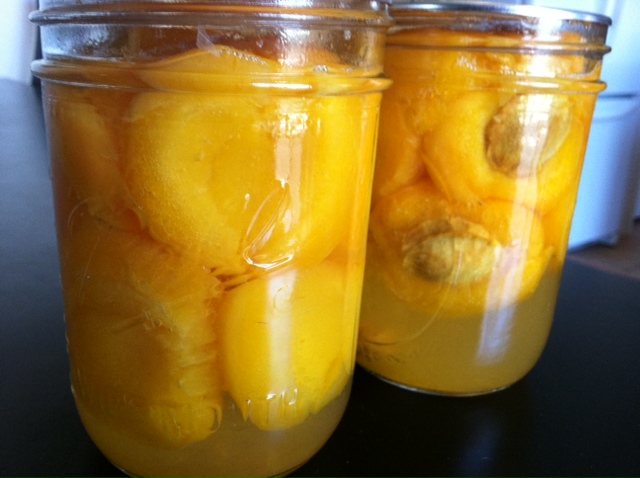
I recently posted a picture of my apricots floating in my jars. Here is why this happens!
Home canned fruit sometimes has a tendency to float. This is not necessarily an indication of food spoilage or poor canning procedures but it can be visually disturbing. Fruit floating could be caused by one, or a combination of, several factors. Some fruits such as apricots, berries and rhubarb have natural buoyancy due to air in the cells. Floating can be controlled by taking into consideration the following:
Ripeness and maturity of the fruit
Use only unblemished fruit at the peak of ripeness.
Packing the jar
Loosely packed jars and improperly exhausted jars cause fruit to float. When putting the fruit in the jar, pack it snugly tight and then add your liquid. After filling the jars to the correct headspace, exhaust any trapped air bubbles by running a plastic chopstick or spatula around the inside of the jar. This dislodges any air under pieces of fruit. You may notice after exhausting that the fruit settles. You may need to add more fruit and/or liquid to maintain proper headspace and tightness of pack. If you do add more product or liquid, exhaust again before putting on the two-piece lid. Also using a regular mouth jar versus a wide mouth will help at the shoulder of the jar to keep all the fruit from floating.
Raw pack vs. Hot Pack
All fruit contains air in the cells. Raw-packing is the practice of filling jars tightly with freshly prepared, but unheated food. It appears to fill the jar. During processing, the air in the fruit is cooked out. The fruit shrinks in size creating more room in the jar, allowing the fruit to rise to the top. Sometimes the fruit rises above the syrup causing discoloration, usually within 2 to 3 months of storage. Hot packed fruit is heated prior to being packed in jars, simmering it 2 to 5minutes, and promptly filling jars loosely with the boiled food. The fruit will have less air and will be more dense, lessening the amount of float and improves shelf life. An additional benefit is more fruit can be packed in the jar and processing time is usually reduced.
Syrup
A heavier or more sugary syrup tends to prevent floating. Light syrups, juice syrups or water creates an environment in which fruit wants to equalize its sugar content with its environment. The fruit releases its own sugar, becoming lighter.
Overprocessing
Be exact according to your recipe. Overcooking the fruit makes the fruit lighter by destroying the cell structure. This also gives the finished product a ragged appearance.
Possible Food Spoilage
In addition to the unappealing appearance, floating can contribute to food spoilage. When the fruit rises above the syrup, discoloration and drying out can occur. In extreme cases the fruit can rise up and touch the lid and even dislodge the lid. Check seals before serving. Store all jars with the rings off once a seal has occurred. If spoilage has occurred dispose of the product correctly. When in Doubt, throw it out!
At first, the color of hot-packed foods may appear no better than that of raw-packed foods, but within a short storage period, both color and flavor of hot packed foods will be superior.
I would like to thank the Washington State- WSU Cooperative Extension Whatcom County and the USDA Complete Guide to Home Canning for the information in this article!


19 comments:
I am curious, why do you say store the food with the rings off?
Good information on trying to prevent floating. I have this issue sometimes. I have found with tomatoes if they float once they are completely cooled if I will turn them upside down and gently giggle the jar so the juice can move around. That usually does the trick to get the tomatoes back down to the bottom :O). I don't know if this is good or bad but it works.
Fantastic, thorough post! I will try hot packing my fruit next time. In the meantime I am indebted to you for laying my fears to rest, and keeping my fridge clear of the 8 jars of floating apricots. They are in the cupboard where we will eat them over the next month or two, before the top floaters turn brown :)
I foresee some ice cream in their future, for sure! Maybe even an apricot tart or something.
--Stacey
I'm glad that you like the post. We store the rings off the jars so that if bacteria gets under the lid or there is some spoilage having the ring on the jar will keep the lid in place and in some cases will not allow the lid to bulge. With the ring off when you go to open it the lid will slide off or pop off in your pantry alerting you not to eat it.
I am glad that I can help with the floaters!
Agree with the answer to Texan's question: NEVER store jarred food with the ring on. It can actually cause problems. Best to remove ring 24 hours after removing jars from processor (bath or pressure canner), check your seals, then wash the jars in hot soapy water and rinse before storage.
I marvel at your apricots, and then, I look and see... WHAT? I DON'T HAVE TO PIT THEM? YEssss!
All these years I've been fiddling with the pits. Did not know they didn't need to come out.
You saved me a LOT of work. Thanks!
Pony!
If you leave the pits in they will have a natural nutty flavor which is delicious. I am glad that I posted the pic and saved you some work!
What about the fruit floating so much it touches the lids, even with hot packing and proper headspace? I have had this issue with apples.
Hi
I found this so with Okra also and I have packed them REALLY tight and even loose trying to see what my issue was with pickling them. Can you make a suggestion?
Thanks so much for this very informative post. I have been canning for quite a few years, but have never figured out why my fruit floats. I will try the hot pack next time. Also, since I only can once a year...my learning curve ha to be restarted each summer. I'm so glad I found you! Great article in the Newspress.
Thanks Carla! I hope that it will inspire you to make a "fall or winter" canning session of our local produce. We are very lucky to have farmers markets all year round.
I would love to hear what you "put up" this season. Keep me posted!
I have been canning lots this year. The two things that I am finding to have issues with floating are peaches and okra. The okra is the worst. It rises way out of the pickling brine all the way to the tops. Would you recommend eating them soon? Or how long do you think they will stay good for? Could I just invert the jars to keep them submerged? Thanks for any advice.
:)Lisa
@Lisa - The jars of food will be good for the year. You might find that the food that is above the brine might start to discolor but as long as the lid is sealed your fine. If you invert the jar the food will still float. Don't invert the jars as you may have a greater possibility of having bacteria grow around the lid than keep them sitting correctly.
Side note: did you blanch the okra?
No, I did not blanch it first. The recipe in Balls book of canning said to just wash and pack into hot jars. I was wondering about that though. What would the difference be?
Thanks for your help!
:)Lisa
It will help with the floating. When the fruit or veggie is hot packed during the blanching it usually releases some of the air which causes them to float in the first place. You could try that and see if it helps. I don't eat okra so I have not experimented with that but if you do and it helps let me know! Thank you for your comment!
I just did my second batch of peaches, which I'm thinking were a different variety than the first peaches I did a month ago. My sugar/water solution is a pinkish/red color and the peaches (which I didn't taste until after I had blanched them all!) were quite a bit more tart than my previous bushel. These are floating so much that they touched the tops and I've got some sugary liquid that has dripped over the sides. I'm sure I didn't leave enough headspace (unless there could be another reason?) and I'm wondering if these are safe to store or should I pop them into the fridge? A seal has formed, but I'm a newbie and nervous about all the things gone awry with this lot!
@Steph, I am new to canning and am experiencing the same situation you ha with peaches on August 31, 2011. Can you tell me what you did. I am thinking of using the reprocess method from the Ball magazine; opening the jar and repack. July 7, 2012
Steph and Debra -
First let me say Steph that I am so sorry that I missed this comment. I would have told you that headspace is very important and that since the lid has sealed that you are fine to keep them on the shelf but remove the rings. If there is a problem and the ring is the lid may come loose and over time the ring will reseal the contents trapping the bacteria. Otherwise they are fine. As far as the color did if you missed some of the peel that would cause the skin color to bleed in the jars. If you use regular mouth jars sometimes you can pack them better. Lately I have been seeing a lot of success with slicing the peaches rather than keeping them in halves to avoid floating.
Debra - If you have sealed jars they will be fine.
This is the best explanation of fruit float I've seen. Thank you!
In response to Steph above, we have a peach orchard with 11 varieties of peaches. A peach variety picked one month apart would definitely be different. Some of our peaches have a red flesh, so thus your sugar solution would be pinkish. Even if you peel it. Also, always taste your fruit before you determine the sugar syrup, whether regular or light or heavy... Peaches vary so much in sweetness/tartness/twang. They also vary in firmness, the firm ones hold up better in a hot water bath!
I''ve mad several batches each of strawberry jam and peach jam. In some jars the fruit has risen to the top, leaving all the fruit pieces at the top, all the jelly at the bottom. Why does this happen? Does jar size make a big difference? It seems it doesn't happen as drastically with short half pint jars, but is pretty bad with pint jars and jelly jars.
Post a Comment